
Choosing the best telescope for beginners in 2025 can feel overwhelming, especially with the wide range of models and features available. For new stargazers, the right telescope should offer clear views, simple handling, and reliable performance without unnecessary complexity. Understanding factors like aperture, mount type, and portability helps ensure a positive first experience with astronomy. These are the same principles reflected in the selection at Elite Telescopes, where beginner and hobby-level telescopes are designed with usability and clarity in mind, making it easier to choose the best telescope for beginners with confidence.
Why Your First Telescope Matters
Your first telescope sets the tone for your entire stargazing journey. A well-built beginner telescope helps you explore the Moon’s craters, observe planetary details, and enjoy bright star clusters with ease. On the other hand, a scope that is unstable or difficult to focus may discourage new users.
A reliable beginner telescope should offer:
- Stable and clear optical performance
- Easy setup and user-friendly handling
- Durable construction
- Manageable weight and size
These qualities help ensure that new observers spend more time enjoying the sky and less time struggling with equipment.
Key Factors to Consider When Buying a Beginner Telescope
Aperture: The Most Important Feature
Aperture, the diameter of the telescope’s main mirror or lens, determines how much light the telescope can collect. More light means brighter and clearer images.
A good aperture range for beginners is 70 mm to 150 mm.
What Different Apertures Provide
- 70–90 mm: Suitable for the Moon, planets, and bright clusters
- 100–130 mm: Better brightness and more detail
- 150 mm+: Even more clarity, though less portable
Remember, a larger aperture is only useful when paired with a stable mount and a practical design.
Understanding Focal Length and Focal Ratio
Both of these impact magnification and field of view.
Focal Length
- Longer focal lengths give higher magnification.
- Shorter focal lengths provide wider views, great for star clusters and large objects.
Focal Ratio (f-ratio)
- f/5 to f/7: Wider views, easier for beginners
- f/8 to f/12: Higher magnification, narrower views
Choosing the right combination helps match your scope to your observing goals.
Types of Telescopes for Beginners
Refractor Telescopes
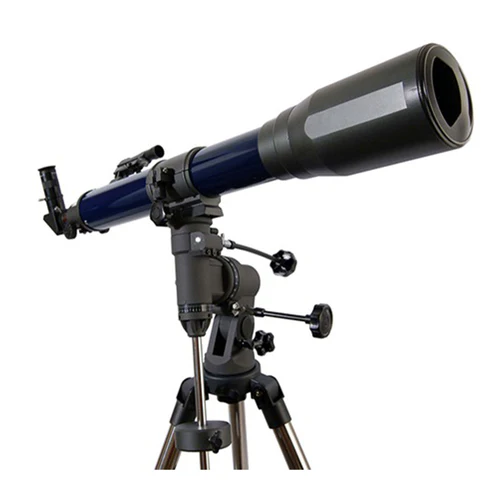
Refractors use a lens at the front of the tube and are known for their sharp, high-contrast images.
Pros
- Clear, high-quality views
- Low maintenance
- Easy setup
Cons
- Larger models are heavier and more expensive
Refractors in the 70–100 mm range are ideal for beginners wanting simplicity and crisp visuals.
Reflector Telescopes
Reflectors use mirrors instead of lenses and offer larger apertures at accessible prices.
Pros
- Great optical performance for cost
- Larger aperture options
Cons
- Occasional alignment may be needed
- Bulkier design
A 114–130 mm reflector is commonly recommended for new observers wanting deeper views.
Catadioptric Telescopes
These hybrid systems combine mirrors and lenses, offering compact yet powerful performance.
Pros
- Portable
- Versatile for both wide and narrow views
- Balanced optical performance
Cons
- Higher cost compared to basic refractors or reflectors
These are ideal for beginners who value compact design and all-around capability.
Telescope Mounts and Why Stability Matters
The mount is crucial for a smooth viewing experience. Even excellent optics can fail if the mount shakes or is difficult to control.
Alt-Azimuth Mounts
- Move up/down and left/right
- Simple controls
- Perfect for beginners
Dobsonian Mounts
- A stable alt-az style used on reflector telescopes
- Very easy to use
- Offers strong support for larger apertures
Equatorial Mounts
- Designed to follow Earth’s rotation
- More complex and better for advanced users
For beginners, alt-azimuth and Dobsonian mounts provide the best balance of stability and simplicity.
Portability and Ease of Use
A telescope that is too heavy or time-consuming to set up often ends up unused. Beginners benefit most from telescopes that are:
- Lightweight
- Easy to assemble
- Simple to transport
- Quick to store in small spaces
Portability directly impacts how often the telescope will be used, which is essential for new observers.
Eyepieces and Basic Accessories
Eyepieces influence what you actually see through the telescope. Many beginner telescopes come with standard eyepieces, but even these can offer great results when matched with the right telescope.
A helpful starter eyepiece set includes:
- Low-power eyepieces for wide views
- Medium-power eyepieces for planets
- A finder or red-dot sight for object locating
As you gain experience, you can add more accessories to enhance your viewing.
Beginner Telescope Comparison Table
|
Feature |
Beginner Recommendation |
Why It Matters |
|
Aperture |
70–150 mm |
Bright, clear images with good detail |
|
Focal Ratio |
f/5–f/10 |
Balance of wide and narrow views |
|
Mount Type |
Alt-Az or Dobsonian |
Simple and stable for new users |
|
Portability |
Lightweight & easy setup |
Encourages frequent observing |
|
Accessories |
Eyepieces, finder |
Helps locate and view objects easily |
Practical Tips for First-Time Telescope Buyers
1. Focus on Aperture, Not Magnification
High magnification does not equal good performance. Beginners benefit more from a clear, bright image at lower power.
2. Avoid Unrealistic Magnification Claims
Some low-quality telescopes advertise extreme magnification levels. These rarely provide usable views.
3. Choose a Stable Mount
A solid mount prevents shaking and helps you track objects smoothly.
4. Set Realistic Expectations
Even excellent beginner telescopes show deep-sky objects as faint or soft. This is normal and part of the learning process.
5. Start with Visual Observing
Astrophotography requires added gear and practice. Beginners should first learn how to use the telescope visually.
Conclusion
Selecting the best telescope for beginners in 2025 means choosing practical features that genuinely improve early observing experiences. Aperture, stability, portability, and ease of use all play roles in making stargazing rewarding. A telescope between 70 and 150 mm, paired with a reliable mount, offers the perfect foundation for exploring the Moon, planets, and bright deep-sky objects.
To explore beginner-friendly options built with these principles in mind, visit Elite Telescopes If you have questions or need guidance on choosing your first telescope, feel free to contact us today.
FAQ
What is the ideal aperture for beginners?
A range of 70–150 mm provides bright and clear views without being too heavy or expensive.
Do beginners need high magnification?
No. A stable, bright view matters more than magnification power.
Which mount type is easiest to use?
Alt-azimuth and Dobsonian mounts are the simplest for new observers.
Do beginner telescopes need maintenance?
Refractors typically need none. Reflectors may need occasional alignment.
Can beginners see planets clearly?
Yes. Saturn’s rings, Jupiter’s bands, and lunar craters are all visible in beginner-friendly telescopes.
Share:
Tips for Observing Planets with Your Telescope
Choosing the Right Premium Telescopes for Clear and Detailed Viewing